
Is Humanism Only Western? A Journey Through Asia
By Billy Pang
In contemporary discourse, humanism is often presented as a distinctly Western tradition—rooted in Enlightenment thought, secularism, and individual rights. Yet this framing raises a deeper question: must humanism always declare itself to exist? In many parts of Asia, humanistic values are rarely labelled as such, but they persist in lived experience—in ethical relationships, civic responsibility, and quiet commitments to human dignity. During my travels through Tokyo, Taipei, and Hong Kong, I began to see that humanism in these cities is not absent, but differently expressed: sometimes constrained by political realities, sometimes openly embraced in democratic life, and sometimes so deeply embedded in cultural practice that it no longer requires a name.
Tokyo
The Tokyo Humanities Café began as part of the non-profit initiative known as the Tokyo Humanities Project. Established in 2016, the project was created by several Tokyo-based scholars, including Laurence Williams, Alex Watson, Samantha Landau, and Koji Yamamoto. Its primary mission was to connect humanities researchers in Tokyo while increasing the international visibility of their work. Initially, the group operated through a Facebook page that promoted upcoming events related to literature and history. Over time, its scope expanded to encompass a broader range of humanities disciplines, including philosophy, politics, music, and sociology, with a particular emphasis on English-language, international, and interdisciplinary discussions.
Another important goal of the project was to highlight Tokyo and Japan as vibrant centres for academic research and scholarly collaboration, while also offering a Japan-based perspective on issues relevant to the global academic community. The Tokyo Humanities Café continues to hold regular events four times a year. The most recent gathering took place on June 5, 2026, featuring presentations by Geoff Baker, David Marx, Keiko Nishimura, and Sven Saaler. Their talks explored topics such as “Belief in Evidence: From 19th Century Novels to the Age of Misinformation”, “Cultural Value Shifts in the 21st Century”, “Why Build a Useless Robot? The Story of Pepper”, and “Heroic Representations of the Nation: Public Statues in Modern Japan”.
Although I was unable to arrive in Tokyo until June 8 and therefore missed this remarkable event, I still hope to experience the intellectual and cultural atmosphere of Tokyo through a visit to Jinbōchō. Known for its long history as Tokyo’s famous “book town,” Jinbōchō is home to numerous bookstores, publishing houses, cafés, and academic spaces that reflect the city’s vibrant humanities culture. Visiting the district would allow me to engage with the scholarly spirit that the Tokyo Humanities Café seeks to promote, while also offering a meaningful opportunity to explore how literature, history, and intellectual exchange continue to shape contemporary Tokyo.
A visit to Jinbōchō can offer far more than simply browsing books. Often regarded as the intellectual heart of Tokyo, the district provides a unique glimpse into Japan’s academic and literary culture. By walking through its streets lined with second-hand bookstores, publishing houses, and small cafés, you can experience the atmosphere of scholarly curiosity and open discussion that has shaped generations of students, writers, and researchers.
My one day trip at Jinbōchō was simple but solid. I started my treasure hunt at the Iwanami Shoten around 9:30 am. You could find fascinating books written by sensei like Kenzaburo Oe or Abe Kobo. I spent a whole morning there and did not find time to fly until I was hungry. I then took my lunch at Curry Bondy. I am not able to tell you how extraordinary this curry shop is. The only way to know it is to visit it by yourself. But please be aware that you have to wait for a seat for more than an hour.
I continued my treasure hunt from the second hand book shops in the afternoon. There you may find a lot of “thread-bound” books written in ancient Chinese. Believe it or not, shop owners told me those books were written in the Qing dynasty and have been there for more than 50 years. I ended my journey in Kanda Brazil, a small café without any luxurious decoration. But the minimal style can let you feel a vibe of humanity.
For your reflection on humanism in Asia, Jinbōchō may also symbolize how knowledge, debate, and cultural memory are preserved within everyday urban life. The area demonstrates that the humanities are not confined to universities alone, but are embedded in public spaces where people gather to read, exchange ideas, and appreciate history. Even without attending the Tokyo Humanities Café, visiting Jinbōchō could still provide you with valuable insight into Tokyo’s intellectual landscape and the enduring role of the humanities in Japanese society. However, I would also expect a Humanities Café in Toronto.
Taipei
Taipei’s humanism is in its nascent and developing stage, emphasizing human-centeredness, rational concern, and critical thinking, and striving to resolve conflicts and build a shared good in a pluralistic society. This trend is closely related to the deepening of democracy in Taiwan, often accompanying the development of local consciousness, and advocating breaking through traditional constraints through rationality and individual dignity.
I visited Huashan 1914 Creative Park on a rainy day. It is one of Taipei’s most celebrated cultural landmarks, where history, art, and innovation converge. Originally established in 1914 during the Japanese colonial period as a winery and sake brewery, the site supplied alcoholic beverages for decades before ceasing production in the late twentieth century. Rather than demolishing the aging industrial complex, the Taiwanese government and local cultural advocates transformed it into a creative park, preserving its distinctive red-brick warehouses while giving them a new purpose. Today, Huashan serves as a vibrant hub for artists, designers, musicians, filmmakers, and entrepreneurs, hosting a constantly changing programme of exhibitions, performances, film festivals, design fairs, and community events.
The park is more than a collection of galleries; it reflects Taiwan’s commitment to cultural preservation and creative expression. Visitors can wander through restored factory buildings, browse independent bookstores and design shops, relax in cafés, or simply enjoy the open green spaces that invite public interaction. By breathing new life into a historic industrial site, Huashan demonstrates how heritage can coexist with contemporary creativity. It has become a symbol of Taipei’s dynamic cultural identity, attracting both local residents and international visitors seeking an authentic experience of Taiwan’s flourishing creative scene.
Huashan is not the only sanctuary of humanities in Taipei. If I could stay a couple of days more, I would like to visit the former residence of Yin Haiguang, a preserved Japanese-style wooden cottage nestled near National Taiwan University in the Da’an District of Taipei. This little cottage symbolizes the enduring values of intellectual freedom, human dignity, and critical inquiry rather than simply serving as the home of a renowned scholar. Unlike other conventional museums that celebrate material achievements, Yin’s residence commemorates the power of ideas. It reminds visitors that the humanities are rooted in the courage to ask difficult questions, to defend freedom of thought, and to respect human dignity even under political pressure. For someone who is exploring whether humanism is exclusively Western, Yin Haiguang’s residence offers a compelling example of Asian humanism in practice. Although deeply influenced by Western philosophers such as Bertrand Russell and Karl Popper, Yin also drew upon the Chinese scholarly tradition of moral responsibility. His life demonstrates humanistic values: reason, integrity, and concern for humanity which can flourish within an East Asian cultural context.
Hong Kong
Unlike Tokyo and Taipei Taiwan, humanism in Hong Kong exists in a more subtle way. Before 2019, upstairs bookstores were vital hubs of intellectual freedom and counterculture in Hong Kong. By operating above ground level to avoid prohibitive street-level rents, these independent shops functioned as critical safe spaces that nurtured civic engagement, alternative politics, and localized literature. They were not only hubs of civic discussion but also as the havens of cultural exchange.
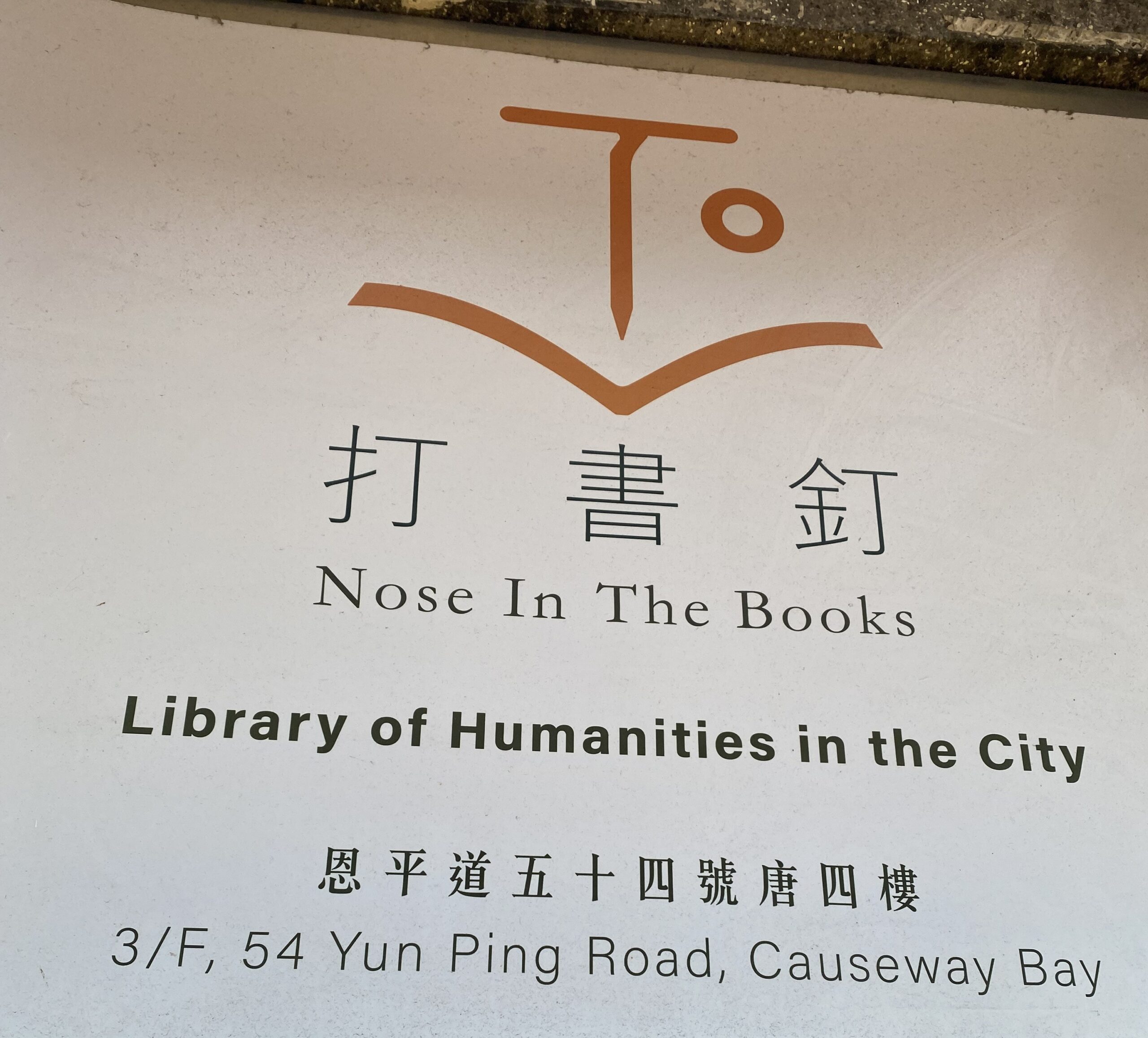
After the summer of 2019, the number of upstairs floor book shops decreased sufficiently. Instead, some private libraries are formed to fill the gap. Nose in the Books is a non-profit library of the humanities in the city, the collection of Nose in the Books combines the donations of local retired professors. It covers a wide range of topics including Hong Kong, gender, culture, urban studies, literature, philosophy and cinema.
Other than opening its doors to readers for bookbinding, the library regularly organizes a series of cultural activities on weekends, such as book clubs, human libraries, and guided tours. It also produces the podcast “Bookcast HK,” introducing books related to Hong Kong. In this demanding environment, groups like the “Bookbinding Group” are truly commendable. It is hoped that more such groups will emerge in the near future to promote the development of humanistic values in Hong Kong.
Conclusion
My journey through Tokyo, Taipei, and Hong Kong has convinced me that the question is not whether Asia possesses humanism, but whether we have been looking for it in the right places. If we expect to find humanism only in formal organizations, philosophical manifestos, or self-identified Humanist movements, we may conclude that it remains largely a Western tradition. Yet my experiences suggest otherwise.
In Tokyo, I discovered a city where the humanities flourish quietly through bookstores, cafés, and conversations that celebrate knowledge and lifelong learning. In Taipei, I encountered a society that embraces creativity, critical inquiry, and democratic values while preserving the legacy of thinkers such as Yin Haiguang, whose commitment to reason and human dignity transcended cultural boundaries. In Hong Kong, I witnessed a more fragile but equally inspiring form of humanism, sustained by volunteers, independent libraries, and ordinary citizens determined to preserve spaces for reading, dialogue, and cultural memory despite changing circumstances.
These places differ greatly in their political systems, historical experiences, and cultural traditions. Yet they share a common belief that human beings are capable of learning from one another, preserving knowledge, and finding meaning through culture and dialogue. None of these places needed to proclaim themselves as “humanist.” Instead, humanism revealed itself through everyday actions: maintaining a bookstore, restoring a historic building, protecting a scholar’s home, lending a book, or gathering strangers together to discuss ideas.
Perhaps this is the greatest lesson of my journey. Humanism should not be understood merely as a Western philosophy that spread eastward. Rather, it is a way of valuing human dignity, reason, compassion, and intellectual curiosity that can take different forms across different civilizations. The language, institutions, and historical contexts may vary, but the underlying aspirations are remarkably similar.
As I returned to Toronto, I found myself reflecting not only on what I had seen in Asia, but also on what might be possible at home. I began this journey searching for humanism in distant cities, yet I ended it wondering how similar spaces could be cultivated within my own community. Perhaps every city needs its own humanities café, its own independent bookstore, or its own gathering place where people can exchange ideas with openness and respect. Humanism, after all, does not belong to any one culture. It belongs wherever people choose to learn from one another and affirm our shared humanity.