
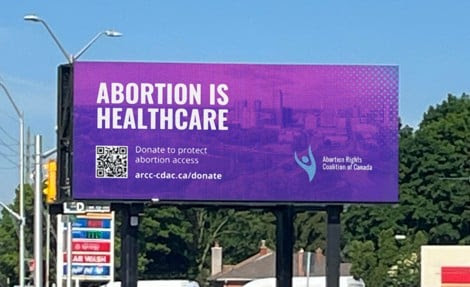
When “Abortion Is Healthcare” Is Treated as Too Controversial to Be Seen By Ruth Henrich, Morgentaler Committee Chair & Choice Chat Podcast Producer
In June 2026, the Abortion Rights Coalition of Canada placed a 10-by-24-foot billboard at Wharncliffe and Southdale Roads in London, Ontario. Its message was direct and factual: “Abortion is Healthcare.” The purpose was not to provoke conflict, but to normalize abortion as part of healthcare and to counter the misinformation and stigma that continue to surround it. Even securing the advertising space had been difficult. ARCC reported that 45 advertising companies declined the advertisement, while another 30 did not respond.
Complaints began on July 8. ARCC was initially told that BillboardHub wanted to “pause” the advertisement and had asked whether its wording could be changed. ARCC refused. The organization then asked supporters to defend the billboard, generating about 300 messages to BillboardHub.
The name BillboardHub may suggest that it owns and operates the billboards it offers, but its role is more accurately described as an advertising intermediary or marketplace. BillboardHub provides advertisers with access to inventory from multiple billboard owners and operators and arranges campaigns, bookings, negotiations and payments. Its own materials state that billboard owners retain control over which advertisements appear on their structures and must approve the sales brought to them through the platform. ( BillboardHub )
That distinction became critical in London. ARCC’s contract was with BillboardHub, which had accepted the advertisement and its message. However, according to ARCC, the organization had not been informed that another company owned or controlled the physical billboard. BillboardHub explained that it lacked final authority to post, continue, or remove the advertisement.
BillboardHub attempted to persuade the owner or operator of the London billboard to reinstate the advertisement and searched for another location in the city. The other company refused to restore the billboard, and no alternative London operator was willing to accept the campaign following the controversy. ARCC will receive a refund and is considering continuing the billboard campaign in another city.
Among the hundreds of constructive messages sent in support of the billboard, some contained aggressive language and personal attacks on BillboardHub staff. ARCC apologized for the harm caused and emphasized that advocacy for reproductive justice must remain principled. Anger at institutional decisions cannot justify targeting individual workers. BillboardHub had attempted to have the advertisement reinstated and had searched for another London location, so ARCC has asked supporters not to contact the company further.
Nevertheless, the larger issue remains. A calm, factual statement identifying abortion as healthcare was removed following complaints. The billboard contained no graphic imagery, attacked no individual and imposed nothing on those who passed it. It simply affirmed that people who require abortion care deserve to see their healthcare recognized publicly and without shame.
The removal of this billboard is another blow to reproductive justice, demonstrating how readily institutions yield to anti-choice pressure while silencing those whose rights, health, and autonomy are actually at stake. What makes this so infuriating is not merely disagreement, but the repeated erasure and delegitimization of one side, as though support for reproductive freedom is unworthy of equal public space, consideration, or respect.
This goes beyond disagreement between people who hold opposing views. It concerns whose speech is treated as legitimate and whose presence in public life is deemed expendable. Anti-abortion messages have long appeared on billboards, in pamphlets and at public demonstrations. When a restrained, healthcare-based message supporting abortion access is treated as uniquely intolerable, the result is not an even-handed response to controversy. It creates an unequal public conversation in which opposition is accommodated while reproductive-rights advocates are expected to soften their language, move elsewhere or disappear.
The very act of removing the billboard proved why it was needed. The billboard was intended to reduce abortion stigma, yet its removal reinforced that stigma. It suggests that abortion may exist within Canada’s healthcare system, but that acknowledging it publicly is somehow improper. It tells people who have had an abortion, or may need one, that their healthcare is still considered too contentious to name openly.
Reproductive justice requires more than the formal availability of a medical service. It requires the freedom to discuss abortion openly, share accurate information, and affirm bodily autonomy without being driven into the shadows by organized opposition. We cannot allow a small but persistent anti-choice movement to dictate which healthcare messages Canadians are permitted to see. This is the moment to speak more clearly, support organizations such as ARCC, challenge institutions that yield to pressure, and insist that reproductive rights be given equal and unapologetic space in public life.
Silence is not neutrality; it allows stigma to prevail. We must refuse to be silenced.